Download PDF The Writing of Cubism: The Construction of a Discourse, 1910-1914, by Dr. Jeanne S. M. Willette
By reading this e-book The Writing Of Cubism: The Construction Of A Discourse, 1910-1914, By Dr. Jeanne S. M. Willette, you will obtain the ideal thing to get. The new point that you do not should spend over cash to reach is by doing it by on your own. So, just what should you do now? Go to the web link web page as well as download and install guide The Writing Of Cubism: The Construction Of A Discourse, 1910-1914, By Dr. Jeanne S. M. Willette You can get this The Writing Of Cubism: The Construction Of A Discourse, 1910-1914, By Dr. Jeanne S. M. Willette by online. It's so easy, isn't it? Nowadays, technology really assists you tasks, this online publication The Writing Of Cubism: The Construction Of A Discourse, 1910-1914, By Dr. Jeanne S. M. Willette, is too.
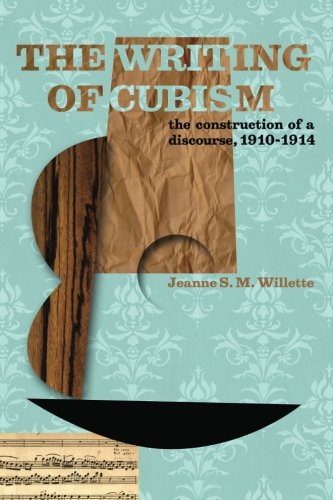
The Writing of Cubism: The Construction of a Discourse, 1910-1914, by Dr. Jeanne S. M. Willette

Download PDF The Writing of Cubism: The Construction of a Discourse, 1910-1914, by Dr. Jeanne S. M. Willette
Find the trick to boost the quality of life by reading this The Writing Of Cubism: The Construction Of A Discourse, 1910-1914, By Dr. Jeanne S. M. Willette This is a kind of book that you need currently. Besides, it can be your favorite publication to read after having this book The Writing Of Cubism: The Construction Of A Discourse, 1910-1914, By Dr. Jeanne S. M. Willette Do you ask why? Well, The Writing Of Cubism: The Construction Of A Discourse, 1910-1914, By Dr. Jeanne S. M. Willette is a publication that has various unique with others. You may not have to recognize which the author is, just how famous the work is. As smart word, never judge the words from who talks, yet make the words as your inexpensive to your life.
Well, e-book The Writing Of Cubism: The Construction Of A Discourse, 1910-1914, By Dr. Jeanne S. M. Willette will make you closer to what you are willing. This The Writing Of Cubism: The Construction Of A Discourse, 1910-1914, By Dr. Jeanne S. M. Willette will be constantly buddy any time. You could not forcedly to constantly complete over checking out an e-book in brief time. It will certainly be simply when you have downtime and also spending couple of time to make you really feel pleasure with what you check out. So, you could obtain the meaning of the message from each sentence in guide.
Do you know why you ought to review this website and also exactly what the connection to checking out book The Writing Of Cubism: The Construction Of A Discourse, 1910-1914, By Dr. Jeanne S. M. Willette In this contemporary age, there are many ways to obtain guide and also they will be considerably less complicated to do. One of them is by obtaining guide The Writing Of Cubism: The Construction Of A Discourse, 1910-1914, By Dr. Jeanne S. M. Willette by on the internet as what we inform in the link download. Guide The Writing Of Cubism: The Construction Of A Discourse, 1910-1914, By Dr. Jeanne S. M. Willette could be an option considering that it is so proper to your necessity now. To obtain guide on the internet is extremely easy by simply downloading them. With this opportunity, you could review the publication any place and whenever you are. When taking a train, awaiting list, and hesitating for a person or other, you can review this on the internet book The Writing Of Cubism: The Construction Of A Discourse, 1910-1914, By Dr. Jeanne S. M. Willette as a great friend once again.
Yeah, checking out an e-book The Writing Of Cubism: The Construction Of A Discourse, 1910-1914, By Dr. Jeanne S. M. Willette could include your buddies lists. This is among the formulas for you to be successful. As recognized, success does not indicate that you have excellent things. Understanding and understanding greater than other will provide each success. Beside, the notification and impression of this The Writing Of Cubism: The Construction Of A Discourse, 1910-1914, By Dr. Jeanne S. M. Willette could be taken and also picked to act.
Based upon primary sources and original documentation, The Writing of Cubism posits that when the art critical writings on Cubism are re-read within their original intellectual and political context, it becomes clear that the historical coincidence of the conception of Cubism on the eve of the Great War had an impact upon the verbal configuration of this new movement that was equal to, if not outweighing, the stylistic innovations and artistic experiments of the artists. Re-reading Cubism in this non-art context as a product of literary institutional practices and political events is a de-familiarizing experience. Rather than being described as art, Cubism, as a concept, was verbally deployed as a nationalist return to French history and tradition at a time when the nation and its art were in peril. To re-read Cubism within its field of critical production is to re-define Cubism from art to strategy. From this point of view, Cubism was an art critical idea tailored to a literary territory marked by intellectual and professional stances taken within the institution of art writing. This field of critical fabrication marked the texts on Cubism with traces of tactical thinking that determined which critical fortresses were held by the already dominant powers, which literary strongholds were entrenched, which positions could be assaulted, and which conceptual weapons could be most effectively employed in the struggle to make Cubism a viable and valid and respected art form that fit neatly into a lineage of classical art.
- Sales Rank: #731588 in Books
- Published on: 2012-12-03
- Original language: English
- Dimensions: 9.00" h x .77" w x 6.00" l,
- Binding: Paperback
- 306 pages
About the Author
An art historian on the faculty of Otis College of Art and Design, Dr. Jeanne S. M. Willette is an art critic based in Los Angeles. In addition to extensive publications of art exhibition catalogues and art critical writings, she is the author and publisher of two websites, Art History Unstuffed and The Arts Blogger.
Most helpful customer reviews
5 of 6 people found the following review helpful.
Potentially interesting but sloppy
By J. C. Evans, Jr.
This is an interesting and informative book. You won’t learn much about Cubism, because, as Professor Willette shows, the public reception of Cubism in newspapers and small journals between 1910 and 1914 was less about works or art than about legitimizing a new movement in art. This is not so surprising to anyone who has read the writing of Gleizes and Apollonaire, but Willette covers a lot of territory in a very useful way, useful, that is, if one is interested in the public reception of Cubism rather than Cubism itself.
Professor Willette writes that the reception was less about Cubism, the new art, than about “a discursive Cubism” that is a construct of a discourse that is ostensibly about Cubism. But the book presents a stronger thesis: It is no accident, she thinks, that the discourse on Cubism deals with a construct rather than the art itself, since this is the general structure of discourse itself. Professor Willette invokes Derrida slogan, “there is nothing outside the text,” and Bourdieu’s neo-Marxist analysis of “cultural production.” The invocations of Derrida are superfluous, since nothing in Professor Willette’s analysis shows that, in a relevant sense, the critical discourse on Cubism could not, for structural reasons, engage the art itself. That a discourse does not engage anything outside of its own concern for legitimation does not show that it cannot. There is nothing deconstructive about Willette’s analysis. Indeed, Willette recognizes that post-WWI discussions of Cubism did indeed engage the works themselves. I leave it to the reader to decide whether the invocation of Bourdieu sheds any real light.
It should be noted that the book is often very sloppily put together. There are a number of typos and stray words. Professor Willette cites a sentence in German (with no English translation offered), not noticing that the sentence says just the opposite of what she says it means. She writes that Kahnweiler, who was Picasso’s and Braque’s dealer “took great pains to disassociate his artists from Cubism. As evidence, she writes the following sentence: “Referring to Picasso and Braque, Kahnweiler stated flatly that ‘Diesen beiden Künstler sind die grossen Begründer des Kubismus’.” Unfortunately, the untranslated sentence means, “These two artists are the great founders of Cubism.” At the bottom of the next page there is a French quote from Kahnweiler (untranslated) that does say what Willette thinks the German sentence says. The fact that the two quotes are separated by eight years, including WWI, and that the artistic climate, including Kahnweiler’s strategic interest, was radically changed, remains unnoticed.
Most of the French texts translated in the main text are offered in the original French in footnotes, which is very useful. Unfortunately, this is not always the case, and in numerous instances shorter quotations are simply left in the French, which will not be helpful to readers who do not know that language.
There are some curious mishaps in the translations themselves. A text translated on pages 146-7 as “Quite naturally and intuitively, the painters began to concern themselves with new measures capable of the breadth that, in the language of the modern studios, was used by everyone to designate the term The Fourth Dimension.” The reader will immediately suspect that something is awry here, and one does not need to know much French to see that this is not an accurate translation of the French text included in the endnote. The odd thing is that on page 174 there is an English translation of a larger portion of the French text that is completely different from the earlier translation, and that gets the above sentence correctly: “Painters have been led quite naturally and, so to speak, intuitively, to preoccupy themselves with the new ways of measuring area now possible, which, in the language of the modern studios, are briefly and globally designated by the term fourth dimension.”
Willette cites a text in which Kant is said to have held that “concepts without precepts are empty and precepts without concepts are blind.” Presumably that should be “percepts.” But Willette had already cited the correct translation, “Thoughts without intuitions are empty, intuitions without concepts are blind.”
0 of 1 people found the following review helpful.
Five Stars
By shawe
was a good read
The Writing of Cubism: The Construction of a Discourse, 1910-1914, by Dr. Jeanne S. M. Willette PDF
The Writing of Cubism: The Construction of a Discourse, 1910-1914, by Dr. Jeanne S. M. Willette EPub
The Writing of Cubism: The Construction of a Discourse, 1910-1914, by Dr. Jeanne S. M. Willette Doc
The Writing of Cubism: The Construction of a Discourse, 1910-1914, by Dr. Jeanne S. M. Willette iBooks
The Writing of Cubism: The Construction of a Discourse, 1910-1914, by Dr. Jeanne S. M. Willette rtf
The Writing of Cubism: The Construction of a Discourse, 1910-1914, by Dr. Jeanne S. M. Willette Mobipocket
The Writing of Cubism: The Construction of a Discourse, 1910-1914, by Dr. Jeanne S. M. Willette Kindle

Tidak ada komentar:
Posting Komentar