Download Ebook The Emotionally Intelligent Investor: How self-awareness, empathy and intuition drive performance, by Ravee Mehta
What sort of publication The Emotionally Intelligent Investor: How Self-awareness, Empathy And Intuition Drive Performance, By Ravee Mehta you will choose to? Currently, you will certainly not take the printed book. It is your time to obtain soft data book The Emotionally Intelligent Investor: How Self-awareness, Empathy And Intuition Drive Performance, By Ravee Mehta rather the printed papers. You could enjoy this soft data The Emotionally Intelligent Investor: How Self-awareness, Empathy And Intuition Drive Performance, By Ravee Mehta in whenever you anticipate. Also it is in expected location as the various other do, you can review the book The Emotionally Intelligent Investor: How Self-awareness, Empathy And Intuition Drive Performance, By Ravee Mehta in your device. Or if you desire a lot more, you could read on your computer system or laptop computer to obtain full display leading. Juts discover it here by downloading the soft data The Emotionally Intelligent Investor: How Self-awareness, Empathy And Intuition Drive Performance, By Ravee Mehta in link page.
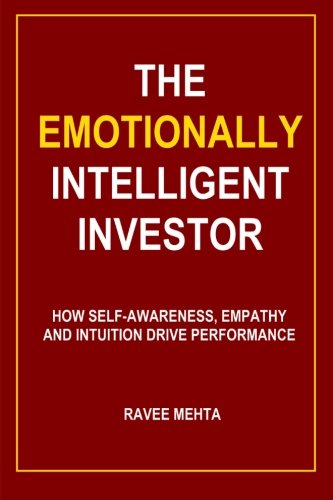
The Emotionally Intelligent Investor: How self-awareness, empathy and intuition drive performance, by Ravee Mehta

Download Ebook The Emotionally Intelligent Investor: How self-awareness, empathy and intuition drive performance, by Ravee Mehta
How a concept can be got? By looking at the superstars? By going to the sea and also looking at the sea weaves? Or by checking out a publication The Emotionally Intelligent Investor: How Self-awareness, Empathy And Intuition Drive Performance, By Ravee Mehta Everyone will have certain characteristic to gain the inspiration. For you who are passing away of books and constantly get the motivations from books, it is truly fantastic to be here. We will show you hundreds collections of the book The Emotionally Intelligent Investor: How Self-awareness, Empathy And Intuition Drive Performance, By Ravee Mehta to check out. If you similar to this The Emotionally Intelligent Investor: How Self-awareness, Empathy And Intuition Drive Performance, By Ravee Mehta, you can likewise take it as all yours.
If you ally need such a referred The Emotionally Intelligent Investor: How Self-awareness, Empathy And Intuition Drive Performance, By Ravee Mehta publication that will certainly give you value, obtain the best vendor from us now from many prominent publishers. If you intend to amusing publications, numerous stories, tale, jokes, and much more fictions compilations are likewise released, from best seller to the most recent released. You could not be perplexed to appreciate all book collections The Emotionally Intelligent Investor: How Self-awareness, Empathy And Intuition Drive Performance, By Ravee Mehta that we will offer. It is not concerning the costs. It has to do with just what you need currently. This The Emotionally Intelligent Investor: How Self-awareness, Empathy And Intuition Drive Performance, By Ravee Mehta, as one of the very best sellers right here will certainly be one of the right choices to review.
Locating the appropriate The Emotionally Intelligent Investor: How Self-awareness, Empathy And Intuition Drive Performance, By Ravee Mehta publication as the right requirement is type of lucks to have. To begin your day or to end your day during the night, this The Emotionally Intelligent Investor: How Self-awareness, Empathy And Intuition Drive Performance, By Ravee Mehta will certainly be proper enough. You could just hunt for the ceramic tile below and you will certainly get guide The Emotionally Intelligent Investor: How Self-awareness, Empathy And Intuition Drive Performance, By Ravee Mehta referred. It will not bother you to reduce your useful time to choose purchasing publication in store. In this way, you will certainly also spend money to spend for transportation and also various other time invested.
By downloading the on-line The Emotionally Intelligent Investor: How Self-awareness, Empathy And Intuition Drive Performance, By Ravee Mehta publication here, you will certainly obtain some benefits not to go with guide establishment. Simply link to the web and also begin to download the web page web link we discuss. Now, your The Emotionally Intelligent Investor: How Self-awareness, Empathy And Intuition Drive Performance, By Ravee Mehta is ready to enjoy reading. This is your time as well as your calmness to acquire all that you really want from this publication The Emotionally Intelligent Investor: How Self-awareness, Empathy And Intuition Drive Performance, By Ravee Mehta
The Emotionally Intelligent Investor challenges several long-held assumptions and beliefs, by asserting that a good investment approach starts with introspection. Too many investment gurus tell you to emulate their techniques despite the fact that you may have very different personality traits, motivations and biases. Would Shaquille O'Neal tell a short basketball player to play like him? This book provides a unique template for self-reflection and a framework for developing an investment approach that works best with who you are.
Whereas the consensus opinion is that investing success comes from blocking out emotions and making purely rational decisions, the best money managers actually use their feelings. They actively sense what others in the market are thinking, and they employ gut instincts when making decisions. Nevertheless, virtually all investing text books neglect to mention how to best cultivate and utilize empathetic and intuitive realizations.
In this book you will learn a process for developing an investing advantage by putting yourself in someone else's shoes. You will also discover how a stock chart is a great tool for understanding what the current holders of a security may be feeling, and you will appreciate why technical analysis works.
This book demystifies intuition with respect to investing and provides a method for building and safely harnessing helpful gut instincts. Traditional security analysis is vital, but in this book you will learn why superior returns primarily depend on self-awareness, empathy and intuition. The book is complete with examples and recommendations that illuminate a path towards reaching full investing potential.
- Sales Rank: #461311 in Books
- Brand: Brand: LES Publishing
- Published on: 2012-08-24
- Original language: English
- Number of items: 1
- Dimensions: 9.00" h x .48" w x 6.00" l, .64 pounds
- Binding: Paperback
- 212 pages
- Used Book in Good Condition
Review
"Ravee Mehta's book is a true breath of fresh air. Through observation and experience, he deduced much of what brain science is teaching about decision making under uncertainty. In a world that still misunderstands human risk decision making, this is an incredible step in the right direction!" - Denise Shull, Author of Market Mind Games
"It is well written and it makes you think about using both emotional factors with qualitative factors. It will make a solid addition to your investment library." - Bud Labitan, Author of The Four Filters Invention of Warren Buffett and Charlie Munger
"It encouraged me to self-reflect more and use empathy, social awareness, technicals and intuition in a more systematic manner while investing." - Shiv Puri, Managing Director and Founder or First Voyager Advisors
"The Emotionally Intelligent Investor is well-written, enlightening, educational and will help any investor make better financial decisions for themselves and their clients. I highly recommend it." - Hendrie Weisinger, Ph.D., Author of The Emotionally Intelligent Financial Advisor
"I devoured this book, scanning through all the best chapters. 90 minutes later I was done. It totally resonated with me. I thought, 'I should have written this book.' That means I loved the book." - Nick Nansen, Founder of Nansen Investments
From the Author
Read my blog and sample chapter 1 at theemotionallyintelligentinvestor.com/?page_id=44
About the Author
Ravee Mehta spent over 11 years working at two multibillion dollar funds: Karsch Capital and Soros Fund Managment. Before joining Soros, Ravee was an investment banking analyst at Donaldson, Lufkin & Jenrette for a couple of years. At the end of 2010, he quit his well-paying job as a managing director of a hedge fund to take a step back and reflect. The Emotionally Intelligent Investor is the product of that time off. Ravee now spends the majority of his time managing his own money and is a contributing writer at Seeking Alpha. He graduated summa cum laude from the University of Pennsylvania with degrees from both the Wharton School of Business and the School of Engineering and Applied Science.
Most helpful customer reviews
19 of 19 people found the following review helpful.
Great Book. Informative and interesting.
By A Benincasa
I liked this book a lot. One of the first things mentioned in this book is a problem that I, and I have to assume many traders, deal with. It is the issue of selling too early, leaving "money on the table" and exiting a trade before it hits your designated sell zone or before it comes to fruition. The author admits (and I appreciate the honesty) that this is a problem that he has grappled with and still deals with. The author suggests that this issue is tied into shame and regret. In other words, there is a sense of shame that develops from having had a profit turn into a loss and obviously, along with that, there is a sense of regret. In my case, I'm not really tuned into a sense of shame, but the regret issue truly strikes a chord. Later in the book the author does implement strategies that deal with these issues. I have always felt the psychological component to be the most important part of the trading equation, but the author states that an edge in the markets is composed not only of a mental edge but also the ability to see patterns and to see them in a way in which they are not seen by the crowd. There are multiple illustrations of real trades and the explanations behind these trades. The author is a successful investor and once worked for George Soros as well as Karsch Capital Management. He now works for himself and manages his personal wealth. In the world of professional performance (investments, athletics, entertainment, etc, I do tend to listen a bit more to someone that has hands on experience. This may be a flaw, I realize that many with no experience in a particular discipline can teach us a lot about that discipline, but I guess what I'm trying to say is that it's interesting to hear from a player and not someone in the dugout).
The book starts by stating that "self awareness" is perhaps one of the most important characteristics that any trader can have. The entire book seems to be based on the premise of, "trader, know thyself". So, what kind of trader are you? Are you a value player that can withstand a stock trading against you for quite a while or are you a short term trader trying to catch the "ebbs and flows". Is your analysis more Macro based or are you comfortable with reading and interpreting charts? Speaking of charts, the author states that he used to look at charts as "voodoo", but has since changed his mind/attitude toward them and now states that charts can give very important psychological information about the types of traders/shareholders involved with a particular equity. His take on charts I found particularly interesting. His interpretation of support and resistance and what it is that brings these about is for me worth the price of the book. I again appreciated the author's honesty in admitting that he once thought charts were almost absurd but now states that any trader that is not aware of at least the basic aspects of support/resistance, euphoria spikes and panic sell-offs, is at a disadvantage. I've always thought it obvious that the lines on a chart hold significant information. So the aspect of self-awareness is critical because if you don't find out what type of trader/investor you are it is somewhat like endlessly trying to fit a round ball into a square hole.
There are many moments while reading this where I recognize that the author is talking about an issue or a subject that has been spoken of before, but he has a different perspective with which I'm not familiar and it just "feels right". Ironically, a significant portion of the book has to do with intuition and developing this special "feel". It is the author's contention that without this feel the trader/investor is at a disadvantage. Where he differs in what I've read before is that he states that intuition, long thought to be some mystical sixth sense, is really the mind recognizing with great speed something it has seen before. It's just that it happens so quickly it seems almost mystical, but it is more the sensing of a pattern with which we are familiar. The author states that intuitive power can be developed, but that it takes effort and time. From what I can see, there are two important modes of development. One is to use visualization and this is explained in detail in the book and the other is keeping a journal. The author is big on diary keeping and journaling. He states that there is empirical evidence as to the positive effects of writing about our trading experiences or for that matter writing about life. He equates journaling to professional athletes watching film and gathering information on what works and what doesn't work all the while keeping in mind the conditions under which these successes and failures take place. He also notes intensely that what works now, the "edge" so to speak, can last for a short duration or many decades. You get the feeling that the edge that can't be taken away is the mental edge. Fundamental and technical edges last only as long as they take to be noticed and implemented by "the crowd". As I said, this can be weeks or decades. The real edge, from what I can see, is mental preparation and the ability to apprehend patterns and to empathize with the other players in the markets. How are patterns noticed? This is delineated in the book and part of it has to do with "deliberate practice". The author near the end of the book analogizes market mastery with chess grandmasters. I found this especially interesting though, as the author states, the comparison begins to break down as the market presents us with an element of randomness/luck that he believes chess does not have or at least does not have in the same way. He gives illustrations of market randomness, how money can be made via pure luck and he addresses what he believes can counteract randomness. To me, this is extremely dangerous because as our luck grows so does our confidence and so does our position size and, well, we all know where this can end. All in all, this is a book well worth adding to your trading library. There's just tons of great information within it. I hope this review helped a little.
26 of 28 people found the following review helpful.
A great book that addresses investing from a unique angle
By hy
I strongly recommend this book to anyone that has an interest in investing. The book is broken down into three parts: Self-Awareness, Social Awareness and Intuition.
In the beginning of Part 1, the author describes the various biases that impact decision making. These behavioral biases have been written about in other books and while good to review, I was already familiar with many of them. This part of the book would probably be more helpful to individual / non-professional investors. However, the book starts to get more unique towards the end of Part 1 when a framework for matching personality traits and motivation with investment style is discussed. I always thought that impulsive and emotionally sensitive people could not be good investors. I now realize that they still can be good, or even great, as long as they adopt an investment approach that fits with their personality.
Part 2 is where the book really gets worthwhile and after reading it, I understand why the author started out with listing so many behavioral biases in Part 1. Everyone has heard of the Warren Buffett quote about "being greedy when others are fearful." I now better understand this statement. A big part of investing success involves taking advantage of the mistakes of other people. It may not sound nice, but the fact is that whenever you buy a stock, someone else is selling it to you so one of you is going to be wrong. After understanding and reviewing the behavioral biases and after showing how you can improve self-awareness to avoid making common mistakes, the author provides a process for how to identify and take advantage of others' poor decisions. I found chapter 8 (Demystifying Technical Analysis) to be the best chapter in the book. As a long term value investor, I never paid much attention to charts. I knew a lot of people looked at them, but I could never understand why. I am now a believer in the charts! I have never seen another book attempt to tie behavioral biases to the principles underlying technical analysis. I now understand why chart reading concepts like support, resistance, breakouts, market breadth, etc. are useful. At the end of Part 2, the book addresses how to use social awareness to get an informational advantage. A lot of communication is non-verbal and the book provides a few examples of how to gain an advantage over others by listening to gut feelings and paying attention to body language. The examples provided were good, but I would have preferred to have a little more depth and more examples in this part of the book.
Part 3 is about Intuition. I always thought intuition was something that you either had or didn't have. After reading this book, I now understand that it CAN be learned. The book provides a process for improving intuition. While there are certainly other people that preach learning from mistakes, this is the first investing book that I have seen that also provides a process for how to safely use intuition and for how to leverage the intuition of others.
The conclusion had a dozen concrete recommendations and changes one can make to improve investment performance based on the concepts laid out in the book. Some of these recommendations seem obvious but others were things I wouldn't have thought about. Professional investors will probably get a little more out of the conclusion than individual investors since many of the "process changes" such as how to recruit better, are more relevant for institutions.
Overall, I thought it was a great book that addresses investing from a unique angle. I have read many investment books and still feel like I learned a lot from this one.
13 of 13 people found the following review helpful.
Recommended Read -- A Professional Investor's Assessment
By Anuj Mathur
BACKGROUND: Similar to the author, I invest for a living, focusing primarily on tech stocks. My assessment is written from the perspective of someone who lives/breathes investing and is constantly looking for ways to perfect my trade.
QUICK ASSESSMENT: I would strongly recommend this book to any individual who is looking to improve their investing skills, ranging from an aspiring investment professional to those simply managing their IRA/401K. The author provides actionable advice for value and growth investors alike. I only wish I would have had this resource available to me when I started my career as a junior research analyst!
A LITTLE MORE DETAIL: The author, Ravee Mehta, has a clear sense of how core financial analysis and research skills, combined with a strong work ethic, can positively contribute to generating attractive investment returns. Luckily for the reader, we are not forced to rehash a set of topics for which there are countless, great reads. Ravee recognizes that these "hard skills" are (relatively) easy to replicate. Therefore, "investment edge" is likely sourced elsewhere. He identifies a set of "soft skills" that are more difficult to define, and as a result teach. That said, Ravee adeptly proceeds to lay out an easy-to-follow and instructive dialogue on how an investor can understand and improve their soft investment skills, which include self awareness, empathy and intuition.
While the premise of the book is itself unique, brilliance is found in the manner that the author addresses these seemingly nebulous concepts (i.e. self awareness, empathy and intuition). The author supports his explanations with numerous real world examples, which is especially helpful in Chapter 8, "Demystifying Technical Analysis". Additionally, the author often provides examples of how he has improved his investor skill set through various activities (i.e. he ends each market day with a few comments in a journal).
From a reader's perspective, not only are there lessons to be learned, but you walk away from each chapter with a game plan (i.e. to hone my self awareness and avoid replicating my mistakes, I can do X, Y and Z). When you complete a book and now reference it as a "resource", you know you've found a gem.
The Emotionally Intelligent Investor: How self-awareness, empathy and intuition drive performance, by Ravee Mehta PDF
The Emotionally Intelligent Investor: How self-awareness, empathy and intuition drive performance, by Ravee Mehta EPub
The Emotionally Intelligent Investor: How self-awareness, empathy and intuition drive performance, by Ravee Mehta Doc
The Emotionally Intelligent Investor: How self-awareness, empathy and intuition drive performance, by Ravee Mehta iBooks
The Emotionally Intelligent Investor: How self-awareness, empathy and intuition drive performance, by Ravee Mehta rtf
The Emotionally Intelligent Investor: How self-awareness, empathy and intuition drive performance, by Ravee Mehta Mobipocket
The Emotionally Intelligent Investor: How self-awareness, empathy and intuition drive performance, by Ravee Mehta Kindle

Tidak ada komentar:
Posting Komentar