Free Ebook Evangelicals, Catholics, and Unity, by Dr Michael S. Horton
Be the first to download this publication now and get all reasons you should read this Evangelicals, Catholics, And Unity, By Dr Michael S. Horton Guide Evangelicals, Catholics, And Unity, By Dr Michael S. Horton is not simply for your tasks or requirement in your life. E-books will always be a buddy in every time you read. Now, let the others understand about this web page. You can take the advantages and also discuss it likewise for your friends and people around you. By this means, you can truly obtain the meaning of this publication Evangelicals, Catholics, And Unity, By Dr Michael S. Horton beneficially. Exactly what do you think of our suggestion below?
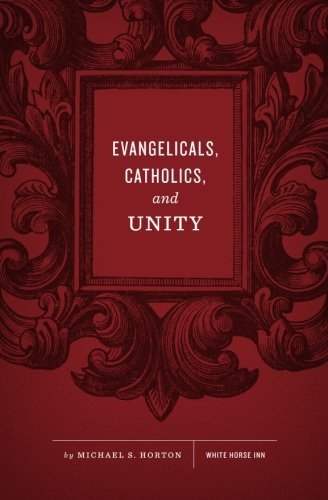
Evangelicals, Catholics, and Unity, by Dr Michael S. Horton

Free Ebook Evangelicals, Catholics, and Unity, by Dr Michael S. Horton
Evangelicals, Catholics, And Unity, By Dr Michael S. Horton. Adjustment your routine to hang or throw away the time to only chat with your good friends. It is done by your everyday, don't you really feel burnt out? Now, we will show you the extra practice that, actually it's a very old routine to do that can make your life more certified. When feeling burnt out of always chatting with your friends all spare time, you could discover guide entitle Evangelicals, Catholics, And Unity, By Dr Michael S. Horton and afterwards review it.
When going to take the experience or ideas kinds others, book Evangelicals, Catholics, And Unity, By Dr Michael S. Horton can be an excellent source. It's true. You can read this Evangelicals, Catholics, And Unity, By Dr Michael S. Horton as the resource that can be downloaded right here. The means to download and install is additionally very easy. You could visit the link web page that we offer and afterwards buy guide making a bargain. Download Evangelicals, Catholics, And Unity, By Dr Michael S. Horton and also you could deposit in your own tool.
Downloading guide Evangelicals, Catholics, And Unity, By Dr Michael S. Horton in this web site listings can provide you more advantages. It will certainly reveal you the most effective book collections and finished compilations. Many books can be located in this site. So, this is not only this Evangelicals, Catholics, And Unity, By Dr Michael S. Horton However, this book is described check out because it is a motivating publication to make you a lot more opportunity to get encounters and also thoughts. This is basic, review the soft file of guide Evangelicals, Catholics, And Unity, By Dr Michael S. Horton and also you get it.
Your impression of this book Evangelicals, Catholics, And Unity, By Dr Michael S. Horton will certainly lead you to obtain exactly what you exactly require. As one of the motivating publications, this book will offer the visibility of this leaded Evangelicals, Catholics, And Unity, By Dr Michael S. Horton to collect. Also it is juts soft file; it can be your collective file in device and also various other device. The crucial is that use this soft documents publication Evangelicals, Catholics, And Unity, By Dr Michael S. Horton to read as well as take the advantages. It is exactly what we suggest as book Evangelicals, Catholics, And Unity, By Dr Michael S. Horton will certainly boost your ideas as well as mind. After that, reviewing book will certainly likewise improve your life top quality much better by taking excellent action in balanced.
“How can the church be the symphony of redemption when its musicians interpret the composition so differently that is sounds more like a wild cacophony than a harmonious concert? The world wonders. And so do we.” So asks Michael Horton in the opening chapter of "Evangelicals, Catholics, and Unity." Isn’t it time for Roman Catholics and evangelicals to finally lay aside their differences and achieve a unified front against secularism? Why are these two groups still divided after all these centuries? Didn’t the Lutherans and Roman Catholics come together already with a joint declaration? As Mark Noll has asked, “Is the Reformation over?” “All this has been confusing and troubling for many believers,” writes Horton, “who sincerely long for greater visible unity among Christ’s flock. We wish for unity but cannot willingly surrender essential truth in order to accomplish a false peace. For those who care about such truth, Christian unity must be a marriage made in heaven, not a merger or acquisition made on earth.” In this compact and thoughtful book, Michael Horton asks if evangelicals can be considered catholic and Roman Catholics evangelical. In six succinct chapters, he helps readers navigate these troubled waters, coming to the conclusion that not only was the Reformation necessary almost five hundred years ago, this important debate continues even today.
- Sales Rank: #2702216 in Books
- Published on: 2012-10-04
- Original language: English
- Dimensions: 8.00" h x .14" w x 5.25" l,
- Binding: Paperback
- 60 pages
About the Author
Michael S. Horton (PhD, University of Coventry and Wycliffe Hall, Oxford) is the J. Gresham Machen Professor of Systematic Theology and Apologetics at Westminster Seminary California, host of the White Horse Inn national radio broadcast, and editor-in-chief of Modern Reformation magazine.
Most helpful customer reviews
6 of 7 people found the following review helpful.
good overview of issues
By Geoffrey S. Robinson
If Catholics want to understand why unity is impossible, I would read this book. Protestants should read it and try to figure out how much truth should be sacrificed on the alter of unity. The most important sections was how the false claims of the papacy rose. I would suggest Calvin's Institutes as another reference. Michael Horton is also an engaging writer. Also deals with core issues such as justification and Catholic veneration of Mary.
5 of 6 people found the following review helpful.
Excellent Overall Summary of What Divides
By rodboomboom
Horton writes an excellent executive summary, if you will, of what truly continues to divide the churches of the Reformation from Rome.
Primarily as then, Rome's insistence on adding to Scripture alone as the only source of theology; of adding to grace and faith alone as the only source of salvation, continues to erect a huge, major divide between the two. As Horton correctly quotes Avery Dulles in Rome's continued holding to the anathemas of Trent as still prevailing now in Vatican II times, this is absolutely Rome's position.
My own church speaks in detail about this. See "The Joint Declaration on the Doctrine of Justification in Confessional Lutheran Perspective" available at [...] or read Robert Preus' excellent work: Justification and Rome.
1 of 1 people found the following review helpful.
More Unity than he Thinks
By Stuart D. Gathman
The Good Points
This tract by Michael Horton has a good apologetic spirit: a genuine concern for telling the truth in love. There is an excellent and, I think, accurate summary of Rome's position viz ecumenism on page 38:
"When the pope [Note: lower case!] prays for unity, what he is asking is that Protestants will cease to be Protestants, that the "separated churches" will at last recognize their heresy and schism and return to submission to his authority. This is not because the pope is arrogant or crafty, but because the Roman doctrine of the church requires this position. That position has been stoutly defended by the magisterium up to the present hour. "
The logic of the paper is impeccable. The overall syllogism is:
Premise Scripture explicity anathematizes salvation by works
Premise Rome teaches salvation by works
Conclusion Therefore, Rome must be anathema.
Note that "anathema" is not a curse, but simply means "not in union with us".
I am writing this because I see a problem with premise two. The arguments against the Magisterium also suffer from some false premises.
Does Rome teach salvation by works?
While arguing that Rome teaches salvation by works, Horton notes on page 25 that Rome successfully resisted Pelagianism in the fourth century. The implicit thesis here seems to be that Rome "fell away" from truth sometime before the Reformation.
On page 26, Horton outlines a shift in vocabulary that took place with the Latin Vulgate. However, when quoting the Council of Trent on the next page, he fails to note that substituting the shifted meaning of "justification" that he just described results in a completely different reading - one that does not so clearly support his thesis that Rome teaches "dikaiooo" by works. Take into account the different definitions of "faith", and the Council of Trent appears to match the very doctrines Horton is trying to defend.
The most egregious error, however, is on page 17. There Horton says that the Council of Trent "declared evangelicals to be anathema". The text he quotes (and the rest as well), however, does no such thing. It declares, "if anyone says that ... let him be anathema". It condemns evangelicals only if evangelicals are making the condemned statements. If we substitute what Horton recognizes as the Catholic default sense of "justification" as "making righteous", and also "faith" with the Catholic default sense of "intellectual assent", we get:
"If anyone says that the sinner is made actually righteous by intellectual assent alone, meaning that nothing else is required to cooperate in order to obtain the grace needed to become righteous . . . let him be anathema."
Does Horton disagree with that statement? I doubt it. If he does, he is condemned by Scripture [James 2] as well as Trent. Are doctrinal differences between Rome and evangelicals simply a matter of language? Maybe not, but teams of theologians have been unable to come to a definite conclusion - so the matter is hardly "clear" as Horton claims.
Does the Magisterium receive new revelation from God?
This is a Catholic FAQ - and Horton should know better. On page 22, Horton says that Rome, like radical sects, claims "ongoing revelation". On page 24, he gives a much more accurate description:
"The purpose of tradition after the apostles is not to reveal new truths, but to illumine, defend, and confess that which has already been revealed, which is why the early church councils appealed to the authority of Christ, the prophets, and the apostles rather than to their own authority as support for their statements."
However, he presents this against his own conception of the Magisterium as "an evolving, post-apostolic, revelatory process." Now, it is alright to claim that in practice the Magisterium has become that (and Catholic apologists will make the same claim about Sola Scriptura) - but to suggest that the Magisterium is formally defined as such is flatly wrong.
[Insert example where Magisterium is defined as never contradicting Scripture or going beyond the teaching of the Apostles.]
In fact, Horton affirms on page 22 that Scripture is to be "interpreted communally and not individually". The real issue is whether the Apostles teaching is authoritatively preserved in Scripture, Magisterium, or both.
Conclusion
In conclusion, Horton says:
"Instead of trying to forge false unity by weakening the only basis upon which true unity may be built, can we not establish church-sponsored forums in which greater understanding and cooperation may be fostered?"
This is exactly what Evangelicals and Catholics Together sets out to do. Michael Horton does a great service in dispelling the popular misunderstanding that ECT means "the issues that have separated the two communions for nearly five centuries were no longer obstacles to genuine unity and ... a shared understanding of the Gospel". However, much more progress needs to made on the "greater understanding" front - as his own misunderstandings of the Catholic positions show.
Evangelicals, Catholics, and Unity, by Dr Michael S. Horton PDF
Evangelicals, Catholics, and Unity, by Dr Michael S. Horton EPub
Evangelicals, Catholics, and Unity, by Dr Michael S. Horton Doc
Evangelicals, Catholics, and Unity, by Dr Michael S. Horton iBooks
Evangelicals, Catholics, and Unity, by Dr Michael S. Horton rtf
Evangelicals, Catholics, and Unity, by Dr Michael S. Horton Mobipocket
Evangelicals, Catholics, and Unity, by Dr Michael S. Horton Kindle

Tidak ada komentar:
Posting Komentar