PDF Ebook Eisenhower's Leadership: Executive Lessons from West Point to the White House, by Brian W. Clark
So, just be here, locate the e-book Eisenhower's Leadership: Executive Lessons From West Point To The White House, By Brian W. Clark now as well as review that swiftly. Be the first to read this e-book Eisenhower's Leadership: Executive Lessons From West Point To The White House, By Brian W. Clark by downloading in the link. We have a few other books to check out in this website. So, you could find them likewise conveniently. Well, now we have done to supply you the most effective book to check out today, this Eisenhower's Leadership: Executive Lessons From West Point To The White House, By Brian W. Clark is truly suitable for you. Never dismiss that you need this publication Eisenhower's Leadership: Executive Lessons From West Point To The White House, By Brian W. Clark to make much better life. On the internet book Eisenhower's Leadership: Executive Lessons From West Point To The White House, By Brian W. Clark will really provide very easy of every little thing to read as well as take the advantages.
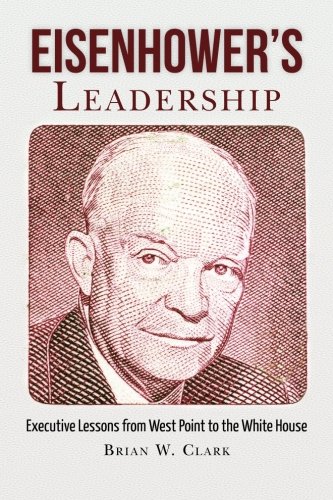
Eisenhower's Leadership: Executive Lessons from West Point to the White House, by Brian W. Clark

PDF Ebook Eisenhower's Leadership: Executive Lessons from West Point to the White House, by Brian W. Clark
Eisenhower's Leadership: Executive Lessons From West Point To The White House, By Brian W. Clark. The industrialized technology, nowadays sustain every little thing the human requirements. It consists of the everyday activities, tasks, office, enjoyment, as well as much more. Among them is the fantastic internet connection and also computer system. This problem will relieve you to support among your hobbies, reviewing practice. So, do you have going to review this e-book Eisenhower's Leadership: Executive Lessons From West Point To The White House, By Brian W. Clark now?
If you ally require such a referred Eisenhower's Leadership: Executive Lessons From West Point To The White House, By Brian W. Clark publication that will give you value, obtain the most effective seller from us currently from lots of prominent publishers. If you wish to amusing books, numerous books, story, jokes, and also more fictions collections are likewise released, from best seller to one of the most current launched. You could not be confused to appreciate all book collections Eisenhower's Leadership: Executive Lessons From West Point To The White House, By Brian W. Clark that we will give. It is not regarding the costs. It has to do with exactly what you require now. This Eisenhower's Leadership: Executive Lessons From West Point To The White House, By Brian W. Clark, as one of the very best sellers right here will be among the right options to review.
Locating the right Eisenhower's Leadership: Executive Lessons From West Point To The White House, By Brian W. Clark book as the best requirement is sort of lucks to have. To begin your day or to finish your day at night, this Eisenhower's Leadership: Executive Lessons From West Point To The White House, By Brian W. Clark will certainly appertain enough. You could simply search for the tile below as well as you will certainly obtain the book Eisenhower's Leadership: Executive Lessons From West Point To The White House, By Brian W. Clark referred. It will certainly not trouble you to reduce your valuable time to choose shopping book in store. In this way, you will certainly additionally spend cash to spend for transport and also various other time invested.
By downloading the online Eisenhower's Leadership: Executive Lessons From West Point To The White House, By Brian W. Clark book right here, you will get some advantages not to choose guide establishment. Just attach to the web as well as start to download the page web link we discuss. Now, your Eisenhower's Leadership: Executive Lessons From West Point To The White House, By Brian W. Clark is ready to enjoy reading. This is your time and also your tranquility to obtain all that you desire from this book Eisenhower's Leadership: Executive Lessons From West Point To The White House, By Brian W. Clark
The Supreme Commander of World War II and leader
of the free world as the American president for much of the 1950s, Dwight D. Eisenhower was one of the twentieth century’s most admired and effective leaders. From his early career in U.S. Army to commanding critical World War II battles and the demands of the Oval Office, this book draws lessons from Eisenhower’s life to give the reader specific actions that can enhance their own leadership. While there are many books about Eisenhower, this book is unique in presenting leadership insights from his military and political careers, rather than just one or the other. Another difference is that some of the material presented has just recently become available, such as Eisenhower’s role in promoting the development of spy satellites and new perspectives into his role in promoting civil rights. The book begins by describing the foundations of his character etched in his childhood and follows him to his college days at West Point. It narrates the pivotal points of his early military career and maps out the profound influence his commanding officers had
on developing his nascent leadership abilities. He climbed through the ranks of the military culminating in the fateful responsibility placed on his shoulders in the days after Japan attacked Pearl Harbor. As president, Eisenhower would end the Korean War, balance the federal budget three times, preside over the federal interstate system we use to this day, and sponsor an early civil rights bill. His entire life is a case study in how to be a successful leader, in business, politics or any endeavor.
- Sales Rank: #1581685 in Books
- Published on: 2012-12-05
- Original language: English
- Number of items: 1
- Dimensions: 9.00" h x .75" w x 6.00" l, .99 pounds
- Binding: Paperback
- 332 pages
Most helpful customer reviews
5 of 5 people found the following review helpful.
Best Book Out There On Leadership...
By Christopher B. Clark
As a professional, I've had the opportunity to read many books detailing examples of how to lead others in a business environment - but I can honestly say that I have truly enjoyed Eisenhower's Leadership the most. This book effectively provides examples from Eisenhower's life that can be applied to everyday situations right away. The lessons presented in this book are not only given as actionable ideas, but they're wrapped in some of histories most gripping stories. The book presents these stories in a way that will consistently hold your interest and make it hard to put down, as you're getting an account of major world events through the lens of someone who was at the front and center of it all. Eisenhower was, in many ways, the "CEO" of World War 2, and there are so many principles to be discovered by his actions in that role that can be learned by reading this book. Beyond that, he continued to demonstrate his leadership abilities as President of the United States - which this book also effectively presents to the reader. As far as I can tell, there is no other source available that takes the life of such a remarkable and complex individual and breaks it down for readers such an effective way. The book stays true to its title and is able to focus on the events in Eisenhower's life that truly highlight his abilities as a leader, and should be required reading for anyone who is in a management or leadership role.
1 of 1 people found the following review helpful.
Remarkable career
By dr
Eisenhower was chosen to be the supreme allied commander in western Europe for one single reason, it was perceived that he was the the best available person to vanquish the Nazis and win the war in Europe as quickly as possible with the least cost to the Allies.
There were many honest people who were not chosen to lead the whole allied shebang in western Europe.
His pledge "I will go to Korea" (to put an end to the war) was decisive in his landslide election victory in 1952.
One key to Ike's success was his insistence on the military doctrine in the Normandy invasion of using maximum force to ensure a relatively quick victory over Germany with the minimum cost, with the indecisive trench warfare of WWI as a negative example that Ike wanted to avoid.
He insisted upon a single command where he would be able to determine the force level without having beg for more force in the middle of battle.
He was concerned about welfare of the fighting men and women and morale, and in this regard he needed to assure them that they had enough military support, overwhelming air power, to win a decisive victory relatively quickly.
He assured his troops that if you look up, that plane in the sky is going to be ours and not German.
Far from being perfectly transparent as this book suggests, Ike was an absolute master of deception, for example getting the Germans to believe that he would launch the invasion at Calais, where the English Channel was narrowest, the landing beaches better and considerably closer to Germany than the actual Normandy beaches the Allies used on June 6th, 1944.
That deception was a big part of the strategy for victory in Europe.
He insisted upon the Normandy invasion and later the invasion through southern France, maximum use of air power in Germany and France to protect his troops, contrary to Churchill's protestations, and the maximum use of force. He was not intimidated by Churchill and often threatened to quit unless he got his way
Similarly he was elected President because he was the one person to stop the war in Korea quickly, keep the peace thereafter, and lead America for eight years.
In Korea and in the world Eisenhower kept the peace by threatening maximum use of force, "massive retaliation."
We know that his successes depended upon a full measure of deception and bluff.
Eisenhower was a lifetime poker and bridge player.
Bottom line, Eisenhower achieved success really because of his conservative,
pragmatic focus, wanting overwhelming military force in battle, middle of the road political approach with getting the job done his first priority, emphasis on getting along with allies, troop morale, and his military strategic skills.
Significantly he went to West Point because the tuition was free, he came from a pacifist family, and not to be the great man on horseback,
He was strongly attached to American democratic values, eschewing both the extreme political left and right.
He was a military professional who warned against the power of the military industrial complex as President.
And said the ideal purpose of the military is to deter war and not to fight wars
This book is interesting but also should be taken with a grain of salt. To make his points, the author produced a book not entirely accurate and not sufficiently nuanced.
It is true that Ike had a remarkable career and he was probably one of the most eminent
personalities, not only in WWII, but in all of recorded history.
Ike was instrumental in winning WWII and with Ike as President we had eight years of peace and full employment after he put an end to
the war in Korea.
Presidents would do well to study Eisenhower's career.
Ike's goal was always to get things done successfully, not to polarize domestic politics, not to get involved with personalities, that is a big point other Presidents sometimes need to learn.
Other books I would recommend are by Eisenhower himself
"At Ease,"
"Mandate for Change,"
"And Crusade in Europe."
While Ike had a strong work ethic it would be unrealistic to expect that Ike was entirely honest in everything he did and said, as this book suggests.
Clearly Ike was not entirely honest in everything he did or said. The dishonesty in the U-2 spying incident against the Soviet Union when Ike was President comes quickly to mind. Ditto Ike's deceptions re the Normandy landing and bluffs in Korea and foreign policy
Generally. (See the book "Eisenhower's Bluff").
Ike's English driver episode, his actual relationship with Kay Sommersby, during and after WWII is another issue somewhat undermining this book's main thesis about Eisenhower's character.
Total candor is not always the best policy for a leader, especially for a President or General.
And that is a blind spot in this book.
In an insightful quote revealing Ike's true attitude toward honesty and leadership
Ike said early on in the African campaign he realized that he needed
To be determined to always APPEAR to be extremely confident at all times
REGARDLESS OF HOW HE ACTUALLY FELT, which was sound thinking
But certainly not lacking in deception or dishonesty. He felt a leader
Needed to be an actor at all times. His role was to play the confident
Leader. Hence the famous Ike smile. Shades of FDR.
Ike worked at getting along with Congress and getting along with everybody to get great things done.
Ike was a skilled politician and diplomat, and these skills require discretion and judgment, but not always complete candor.
One absolutely spine chilling quotation not in this book.
"I realized that the success of the whole operation (defeat of the Nazis) would depend upon what those boys do when they hit
The beaches in Normandy, if they fight, we win, if not, we lose"
In Mandate For Change, Ike describes in detail how and why he avoided
Being caught in the quagmire in the Asian mainland in Vietnam, (as his three successors tragically did).
When resorting to force, there is one thing you must never do, do not lose.
Pick your battles, do not engage in force unless you are prepared to use overwhelming force,
So overwhelming so that you will not lose.
IF YOU ENGAGE IN FORCE ONE THING YOU MUST NEVER DO, DO NOT LOSE.
An extremely important insight into Ike's thinking that explains his success in WWII, and his
Success in keeping the peace as President, why he settled for a truce in Korea, refused to send American combat troops to Vietnam, refused to provide air support to the French in Vietnam, refused to support
the Anglo French Suez Canal adventure, refused to engage American force at the time of the Hungarian uprising
He prevailed without a shot being fired in Lebanon and Little Rock, Arkansas.
And Ike did not lose against his political opposition at home, did not lose against Joe McCarthy nor governor Faubus of Arkansas.
Ike just knew the "Art of War" better than other Generals, Presidents, and his adversaries.
IF you engage force, the one thing you must not do is lose.
According to Eisenhower he did the master planning for the winning of WWII, first defeat Hitler, Europe should be the first priority even though Pearl Harbor was in the Pacific and attacked by the Japanese, drive the Germans out of North Africa because of the oil, the Italian campaign, clear the Mediterranean for Allied shipping, and the Normandy invasion as the quickest least costly way of defeating the Nazis, because Britain was potentially a military base accessible to the United States and relatively close to Germany through which Germany could be defeated with the least formidable natural impediments to the invasion of Germany.
Ike wrote that in the beginning of WWII after Pearl Harbor he met enormous opposition and discouragement within the Allied camp about his scheme to invade Europe and invade Germany by crossing the English channel at Normandy. He said opposition to the Normandy invasion strategy was close to 90%, Churchill was opposed to the Normandy invasion for years before D Day because he felt that a cross channel invasion of Europe was just too risky. Churchill favored an invasion from the eastern Mediterranean through what Churchill called the "soft underbelly of Europe".
In the Normandy invasion he attacked with overwhelming air power and force, the one thing he was not going to do was to launch an invasion of Normandy and lose.
Ironically while Ike was President he was ridiculed by the political opposition for being not too forceful, not to bright, ineffective, lazy, guilty of playing golf too much, and not preparing for local wars like Vietnam.
In fact from 1941 to 1973, the Eisenhower Administration years was the only 8 year period of peace and prosperity, putting an end to the territorial expansion of Communism, rolling Russia back from Austria by negotiation, rising employment, low unemployment, low inflation, national debt as a percentage of the GDP dropped sharply, progress in Civil Rights, and no American servicemen killed in action during his watch, after he ended the Korean War in June 1953, only 6 months after his inaugural.
Some of Ike's judgements remain controversial, for example the execution of the atomic spies,the Oppenheimer case.
He opposed dropping of the atomic bombs on Japan because he said Hitler was defeated already, and Japan had already been de facto defeated, although not yet formally surrendered, every major city in Japan had already been thoroughly destroyed except Hiroshima and Nagasaki, which were left intact so that they could be A bombed.
He opposed massive American disarmament in Europe and Korea after WWII
and was proven right.
He opposed the strategic policy of the US insisting that Russia declare war on Japan on August 8th, 1945 (after Japan was de facto already destroyed and defeated by the United States, although not yet formally surrendered).
Russia declaring war on Japan, at America's insistence, after Japan was virtually already defeated by the US helped to give Stalin a foothold in China and North Korea, since they quickly occupied territory that had been controlled by the Japanese before their formal surrender only a few weeks later on September 2, 1945. This set the stage for the Korean War in 1950 when the Communist occupied North invaded South Korea.
Instead of supporting Joe McCarthy as his Presidential successor had done when he was a Senator,Ike undermined and defeated McCarthy and McCarthyism.
Ike's great achievements in desegregation and civil rights, and in Little Rock, are mostly ignored in this book.
Ike also had humanitarian achievements in the Philippines during the late 1930s.
See the new movie "Rescue in the Philippines" involving Ike as a key player.
0 of 0 people found the following review helpful.
GREAT FORMAT...History Teaching leadership
By Sean
The Author has taken one of the significant leaders of the 20th Century and catalogued his growth while providing parallel lessons to be applied to business leadership and growth.
Importantly, we also are provided with great history lessons.
Eisenhower was not identified as a significant candidate for high-level leadership at the beginning of his military career but through patience, observation (Douglas MacArthur in particular) and humility became an adaptive leader who continually learned during his career.
These experiences and abilities were recognized by another great leader, George Marshal when he was looking for a commander of the US Armies at the beginning of WWII. This is an important lesson for business leadership to learn from others, continually grow and reach into the ranks to find others to delegate to.
We are guided through various situations, but importantly 3 of the most critical and challenging periods of the 20th century, WWII, Korea and the threat of Nuclear Annihilation and shown where pragmatism and experience allowed him to adapt, manage and seek counsel from others with these monumental challenges.
This book also shows how even the most powerful man in the world showed humility and respect for others when making tough decision's were required. This was particularly demonstrated with Eisenhower's termination of George Patton's position at the end of WWII despite their mutual respect and friendship.
Finally Eisenhower was a leader who understood what he required of his subordinates and made a point to press the flesh and let people know that he appreciated their sacrifices, and ensured them that he was confident in their abilities. This was particularly important with the execution of D Day operations in June 1944, as he understood that he was sending his troops into harms way but needed to show them confidence i that desision
Overall Eisenhower is an individual that we can relate to and lookup to as one of the great managers and leaders of our recent past.
A great book to share with others on your teams.
See all 8 customer reviews...
Eisenhower's Leadership: Executive Lessons from West Point to the White House, by Brian W. Clark PDF
Eisenhower's Leadership: Executive Lessons from West Point to the White House, by Brian W. Clark EPub
Eisenhower's Leadership: Executive Lessons from West Point to the White House, by Brian W. Clark Doc
Eisenhower's Leadership: Executive Lessons from West Point to the White House, by Brian W. Clark iBooks
Eisenhower's Leadership: Executive Lessons from West Point to the White House, by Brian W. Clark rtf
Eisenhower's Leadership: Executive Lessons from West Point to the White House, by Brian W. Clark Mobipocket
Eisenhower's Leadership: Executive Lessons from West Point to the White House, by Brian W. Clark Kindle
! PDF Ebook Eisenhower's Leadership: Executive Lessons from West Point to the White House, by Brian W. Clark Doc
! PDF Ebook Eisenhower's Leadership: Executive Lessons from West Point to the White House, by Brian W. Clark Doc
! PDF Ebook Eisenhower's Leadership: Executive Lessons from West Point to the White House, by Brian W. Clark Doc
! PDF Ebook Eisenhower's Leadership: Executive Lessons from West Point to the White House, by Brian W. Clark Doc